How Long Does It Take to Sell a House in New York? Real Timelines

There's no single legal clock for selling a house in New York. Split it into two: the days your home sits on the market until you have a signed contract, and the weeks after that for attorney, title, and (if the buyer is borrowing) lender work. For Long Island single-family homes, OneKey MLS put the June 2026 median days on market until sale at 42 in Nassau County and 44 in Suffolk County (OneKey MLS Nassau Local Market Update, June 2026, data as of 2026-07-08). That number stops at contract, not at the keys, so the real answer is the two clocks added together.
I'm Mike Plactere. I buy houses directly across Nassau and Suffolk, pay cash, renovate them, and resell them. I've bought over 300 homes on Long Island since 2019, and I'm going to walk you through how the timeline actually works here, without the fake promises you'll see on other cash-buyer sites.
What "sold" actually means in New York
A handshake, a verbal "yes," or a signed offer sheet is not a sale in New York. A contract for the sale of real property is void unless it's in writing, states the consideration, and is signed by the party being held to it (GOL §5-703). Until that written contract is fully signed by both sides, either party can still walk.
That matters for timing, because New York is an attorney state. After a buyer and seller agree on a number, the attorneys draft and negotiate the actual contract before anyone signs. New York doesn't have a New Jersey-style statutory attorney-review window. There is no law giving you three business days to cancel after signing. The negotiation happens before signatures, as a matter of local practice, not because a statute forces a review period (NYC Bar process overview, editors dated Sept 2017).
So when people ask how long a sale takes, they're usually mixing two very different things. Let me separate them.
Clock one: days on market until you're under contract
This is the marketing phase. Your house is listed, buyers see it, someone makes an offer, and you agree. The industry number for this stretch is "days on market until sale," and it doesn't include the weeks after you sign.
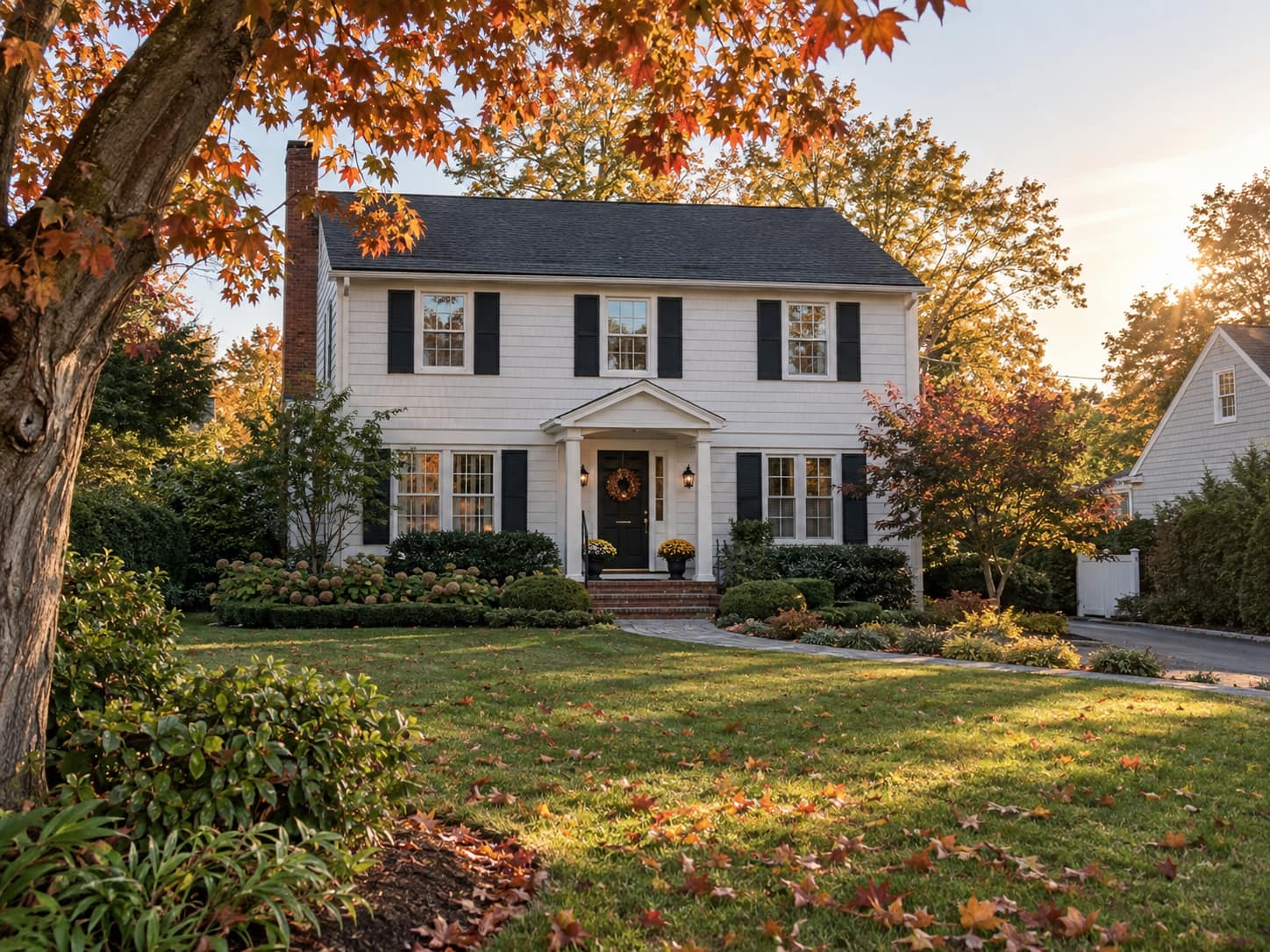
Here's where Long Island stands in the most recent OneKey MLS single-family data (this is industry data, not law, and it updates every month):
| County (single-family) | Median days on market until sale, June 2026 | Median sales price, June 2026 |
|---|---|---|
| Nassau County | 42 | $875,000 |
| Suffolk County | 44 | $750,000 |
Sources: OneKey MLS Nassau Local Market Update, June 2026, data as of 2026-07-08; OneKey MLS Suffolk Local Market Update, June 2026, data as of 2026-07-08.
Now the seasonality, because a single number hides it. Earlier in 2026, the same single-family homes were sitting longer:
| County (single-family) | Median days on market until sale, March 2026 |
|---|---|
| Nassau County | 58 |
| Suffolk County | 59 |
Sources: OneKey MLS Nassau, March 2026, as of 2026-04-07; OneKey MLS Suffolk, March 2026, as of 2026-04-07.
Late winter is slower than early summer. A house in Levittown or Huntington Station listed in March can take a couple of weeks longer to go under contract than the same house listed in June. These figures move month to month, so check the current OneKey report before you plan around any of them.
One more caution. Statewide numbers are not Long Island numbers. The New York State Association of Realtors put the statewide median days on market until sale at 55 in May 2026, with a statewide median sales price of $444,510 (NYSAR Monthly Market Indicators, May 2026, as of 2026-06-10). That statewide price is far below what a Nassau or Suffolk house sells for, so don't use a statewide figure to price or time a Long Island sale.
Clock two starts when you sign the contract
Once you're under contract, the second clock begins. This is the part most articles skip, and it's where the real time goes.
Before you sign, the seller of a covered one-to-four family home has to complete a Property Condition Disclosure Statement and deliver it to the buyer before the buyer signs the binding contract (RPL §462). The current state form is the DOS-1614-f, Rev 02/25. Selling "as is" is still allowed, and the disclosure doesn't force you to make repairs.
Here's a change a lot of older articles get wrong. There used to be a $500 credit a seller could give the buyer instead of delivering the disclosure. That option is gone. As of the March 2024 amendments, a seller is liable under the article only for a willful failure, and the remedy is the buyer's actual damages, not a flat $500 (RPL §465, revised 2024-03-29). If a site tells you that you can just pay $500 to skip the disclosure, it's out of date.
The attorneys handle the deposit at signing as well. In New York practice, the buyer commonly puts roughly 10% of the price into the seller's attorney's escrow account (NYC Bar overview). None of this is a fixed statutory number of days. It's negotiation, and it usually runs a week or two before both sides sign.
Contract to close when the buyer has a mortgage
If your buyer is borrowing, this is the slow half of the whole deal, and it's worth understanding why.
A financed contract usually has a mortgage contingency: a negotiated period for the buyer to get a written loan commitment, and the right to cancel and recover the deposit if the financing falls through (NYC Bar overview). That period is a blank the attorneys fill in, not a fixed statutory number.
Then the lender's own clock runs. Underwriting takes weeks, the lender orders an appraisal, and title has to be searched and cleared. On top of that, federal rules set a floor near the finish line. The buyer must receive the Closing Disclosure at least three business days before the loan closes (12 CFR §1026.19(f); CFPB). If certain terms change late, such as the APR or the loan product, that three-day clock restarts (CFPB TRID FAQs). Those rules don't set the total underwriting time. They just make sure the end can't be rushed.
Add it up and a financed sale on Long Island is weeks of marketing, plus attorney contract negotiation, plus a multi-week lender and title process after signing. The lender is almost always the longest pole in the tent.
Contract to close when the buyer pays cash
A cash sale removes the pieces of the mortgage process I just described. There's no loan application, no underwriting, no lender appraisal requirement, and no federal Closing Disclosure three-business-day wait, because there's no loan (compare 12 CFR §1026.19(f)). Cash usually drops the mortgage contingency too. That's real, and it's why a cash deal can move faster than a financed one.
Cash isn't a legal shortcut around New York's process, though. A cash sale still needs a written contract (GOL §5-703), attorney work on both sides, a title search and clearance of any liens or judgments, municipal searches, the transfer-tax forms, and recording at the county clerk. Those steps still set the calendar.
So when you see a company promise to close in 7 days, be skeptical. In New York, with attorney review and title work, a true 7-day close is rarely realistic. Against a financed sale, a clean cash deal on Long Island tends to land somewhere in the 14 to 28 day range, depending on how fast the attorneys move and whether title comes back clean. What I give you is a cash offer within 24 hours and a closing on your timeline. The fake 7-day promise is one of several patterns worth knowing before you sign anything; our guide to avoiding we buy houses scams in New York covers the rest.
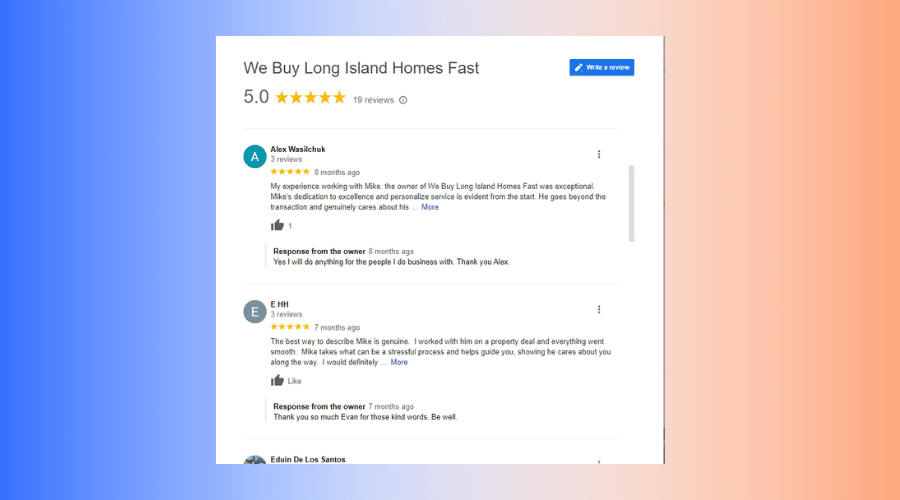
Real sellers describe it that way too. Here's Brandon Oneil, in his own words from a Google review: "Michael Plactere made the whole process easy and seamless. He was honest, kept me updated, and delivered on what he promised. I'd definitely recommend him to anyone looking to sell their home."
Sellers who want a little more runway often ask for about 30 days so they can move out on their own schedule. That's a choice they make, not a speed I'm selling you.
The closing and recording package
Whether the buyer is cash or financed, New York wraps every sale with the same tax and recording steps. These rarely add months, but they're real work, and they're why "sold" and "recorded" are not the same day.
- New York State real estate transfer tax applies to a sale over $500, at a base rate of $2 for each $500 of price, and it's generally paid by the seller (NYS Department of Taxation and Finance). The tax is due no later than 15 days after the deed is delivered (NYS DTF, law as of 2025-01-01).
- The "mansion tax" adds 1% on a residential sale of $1,000,000 or more, and it's generally paid by the buyer (NYS DTF). On Long Island that's not just an East End issue. Plenty of Nassau North Shore homes in places like Locust Valley or Glen Cove clear $1M.
- Two forms travel with the deed: Form TP-584, the combined transfer tax return, and Form RP-5217, the real property transfer report required to record.
- The deed and its package get recorded at the county clerk: the Suffolk County Clerk or the Nassau County Clerk.
If your house is on the East End, there's one more layer. The Peconic Bay Community Preservation Fund is a local transfer tax in the five East End towns: Riverhead, Southampton, East Hampton, Shelter Island, and Southold (authority under Tax Law §1449-bb). Southampton, for example, charges 2.5% (including a 0.5% Community Housing Fund), with the first $400,000 of an improved residential sale exempt when the price is $2,000,000 or less (Town of Southampton FAQ). The rate and exemptions are set town by town, so check the specific town's current rules, for example Southold, before you rely on a number.
The 90-day rule for institutional buyers, and who it actually covers
You may have read that a cash buyer has to wait 90 days. That's a real law, but it doesn't mean what it sounds like, and it doesn't apply to every cash buyer.
Real Property Law Article 16 took effect on 2025-07-01. It makes it unlawful for a "covered entity" to purchase, acquire, or even offer to buy a one-or-two family residence unless the home has been listed to the general public for at least 90 days, and changing the asking price restarts that 90-day clock (RPL §521).
The catch is who counts as a covered entity. The law targets large institutional real estate investors, roughly defined as an entity that owns at least 10 single or two-family homes, manages pooled investor money as a fiduciary, and has at least $30 million in net value or assets under management, plus entities those investors fund to make purchases (RPL §520). A local direct buyer isn't the giant fund this rule was written to slow down. So no, an ordinary Nassau or Suffolk seller working with a local cash buyer isn't stuck waiting 90 days before an offer. If any buyer ever tells you a sale is delayed by this rule, ask them straight whether they're a covered institutional investor.
What actually slows a Long Island sale
When a sale drags, it's usually one of these, not the calendar itself:
- Title problems. Old liens, judgments, or a mortgage that has to be paid off and cleared before the title is marketable. This is often the biggest post-contract delay. We cover how each type clears in selling a house with a lien in New York.
- Open permits or missing certificates of occupancy. Work done without a permit on a house in Suffolk or Nassau can hold up a closing until the town signs off. Full guide: selling a house with code violations or open permits on Long Island.
- Financing trouble. A buyer's loan slips, or a late change forces a fresh Closing Disclosure and restarts the three-business-day wait (CFPB TRID FAQs).
- A soft closing date. Unless the contract says "time is of the essence," a closing can slide with reasonable postponements (NYC Bar overview).
- Out-of-state or nonresident sellers, who may need an estimated income tax form at recording, which is one more item in the closing package. The details live in our guide to capital gains tax when you sell a house in New York.
A cash, as-is sale removes the financing risk and the lender's timeline. It doesn't remove a title cloud or an open permit. Those still have to be cleared, and a good attorney and title company are what actually get you there.
FAQ
What is the fastest a house realistically sells in New York?
There's no statutory minimum, and no single number that covers every sale. The marketing clock alone ran a median of 42 days in Nassau and 44 in Suffolk for single-family homes in June 2026 (OneKey MLS, as of 2026-07-08), and higher in late winter, then the contract-to-close clock runs on top of that. A cash sale shortens the back half by removing the lender, but the attorney, title, tax, and recording steps still apply.
Can I close in two weeks?
Sometimes, with cash and clean title. Against a financed sale, a clean cash deal on Long Island often runs in the 14 to 28 day range, driven by how fast the attorneys and title company move. Title surprises are real, so the date gets set once we know what we're dealing with. I give you a cash offer within 24 hours and we set a closing date that works for you.
Does every cash buyer have to wait 90 days before buying my house?
No. The 90-day public-listing rule applies only to large institutional investors that meet the statutory tests (RPL §§520-521, effective 2025-07-01). A local direct buyer isn't that kind of entity, so an ordinary Long Island sale isn't blocked by it.
What happened to the $500 disclosure credit?
It was removed. Since the March 2024 amendments, a seller who doesn't deliver the Property Condition Disclosure Statement isn't charged a flat $500. A seller is now liable only for a willful failure, and for the buyer's actual damages (RPL §465, revised 2024-03-29). The disclosure is still required before the buyer signs a binding contract on a covered one-to-four family home (RPL §462).
Do I have to make repairs or fill out the disclosure if I sell as-is?
You still complete the disclosure form on a covered home, but "as is" agreements are expressly allowed (RPL §462). When I buy, you make no repairs, do no cleaning, and hold no showings. I buy in any condition. More on how the as-is route works in our guide to selling a house as-is on Long Island.
When is the best time to sell for a faster sale?
Historically the market moves quicker in spring and early summer than in late winter. On Long Island single-family homes, the median days on market until sale was 42 in Nassau and 44 in Suffolk in June 2026, versus 58 and 59 back in March 2026 (OneKey MLS). These numbers update monthly, so check the current report.
A note on this information
This article is general information about how New York and Long Island home sales work. It isn't legal, tax, or financial advice, and every sale is specific to the house, the parties, and the contract. Talk to your own attorney and tax advisor. The market figures here are dated on purpose and change month to month, so confirm the current numbers before you rely on them.
Sources
- General Obligations Law §5-703: https://www.nysenate.gov/legislation/laws/GOB/5-703
- Real Property Law §462 (disclosure before binding contract): https://www.nysenate.gov/legislation/laws/RPP/462
- Real Property Law §465 (liability, no $500 credit): https://www.nysenate.gov/legislation/laws/RPP/465
- Real Property Law §520 (Article 16 definitions): https://www.nysenate.gov/legislation/laws/RPP/520
- Real Property Law §521 (90-day public-listing rule): https://www.nysenate.gov/legislation/laws/RPP/521
- Tax Law §1449-bb (Peconic Bay CPF authority): https://www.nysenate.gov/legislation/laws/TAX/1449-BB
- DOS Property Condition Disclosure Statement, DOS-1614-f (Rev 02/25): https://dos.ny.gov/system/files/documents/2025/05/dos-1614-f-property-condition-disclosure-statement_04.2025-eff.-07.2025.pdf
- 12 CFR §1026.19 (TRID timing): https://www.consumerfinance.gov/rules-policy/regulations/1026/19
- CFPB, Closing Disclosure three-business-day rule: https://www.consumerfinance.gov/ask-cfpb/what-is-a-closing-disclosure-en-1983
- CFPB, TRID FAQs (corrected Closing Disclosure restart): https://www.consumerfinance.gov/compliance/compliance-resources/mortgage-resources/tila-respa-integrated-disclosures/tila-respa-integrated-disclosure-faqs
- NYS Department of Taxation and Finance, real estate transfer tax overview: https://www.tax.ny.gov/bus/transfer/rptidx.htm
- NYS DTF, transfer tax payment timing (15 days): https://www.tax.ny.gov/data/stats/ter/fiscal-year26/real-estate-transfer-tax.htm
- NYS DTF, Form TP-584 index: https://www.tax.ny.gov/forms/real_prop_tran_cur_forms.htm
- NYS DTF, Form RP-5217 transfer reporting: https://www.tax.ny.gov/pit/property/new-homebuyers/transfer-reporting.htm
- Suffolk County Clerk, how to record a deed: https://suffolkcountyny.gov/Elected-Officials/County-Clerk/Recording/Deed-Fee-Schedule/How-to-Record-a-Deed-and-Avoid-Rejections
- Nassau County Clerk, land records: https://www.nassaucountyny.gov/3998/Land-Records
- Town of Southampton, Community Preservation Fund FAQ: https://www.southamptontownny.gov/faq.aspx?TID=28
- Town of Southold, Community Preservation Fund FAQ: https://www.southoldtownny.gov/Faq.aspx?TID=29
- NYC Bar, buying and selling real property (practice overview): https://www.nycbar.org/get-legal-help/article/real-property-law/purchase-sale-real-property
- OneKey MLS Nassau County Local Market Update, June 2026 (as of 2026-07-08): https://www.lirealtor.com/docs/default-source/default-document-library/nassaucounty3f7af90a.pdf
- OneKey MLS Suffolk County Local Market Update, June 2026 (as of 2026-07-08): https://www.lirealtor.com/docs/default-source/default-document-library/suffolkcountyc5a176c0.pdf
- OneKey MLS Nassau County, March 2026 (as of 2026-04-07): https://www.lirealtor.com/docs/default-source/default-document-library/market-reports/nassaucounty.pdf
- OneKey MLS Suffolk County, March 2026 (as of 2026-04-07): https://www.lirealtor.com/docs/default-source/default-document-library/market-reports/suffolkcounty.pdf
- NYSAR Monthly Market Indicators, May 2026 (as of 2026-06-10): https://www.nysar.com/wp-content/uploads/2026/06/NYSAR_MMI_2026-05.pdf
Sell your Long Island house without the guessing
If you want out of the two-clock waiting game, I buy houses directly across Nassau and Suffolk, from Huntington Station to Levittown to Glen Cove and the East End. I'm Mike Plactere, a licensed CPA and a licensed New York real estate agent, and I've bought and renovated over 300 homes and more than $130 million in property on Long Island since 2019.
Here's how I work. I give you a cash offer within 24 hours. I buy as-is, in any condition, so you make no repairs, do no cleaning, and hold no showings. No fees, no commissions, and I pay all closing costs. Proof of funds is available on request, because I'm the buyer. I don't tie your house up and shop the contract to someone else.
Some companies promise to close in 7 days. In New York, with attorney and title work, that's usually not realistic. I close on your timeline, and plenty of sellers pick a date around 30 days out to move on their own schedule. A cash offer is below full retail. What you get in return is speed, certainty, no repairs, no commissions, and a buyer who doesn't renegotiate at the closing table.
As John Shicko put it in his review: "Mike was an absolute pleasure to work with. Super nice guy who actually cares about his customer and will go above and beyond for them. I would highly recommend him to anyone looking to sell their home fast and hassle free."
Call or text 631-825-8747, or stop by the office at 173 Birch Hill Rd, Ste. B, Locust Valley, NY 11560. We hold 48 five-star Google reviews and an A+ rating with the Better Business Bureau. Let me give you a real number and a real timeline.